Monthly Archives: March 2012

1. Referents such as ‘he, it, they, one, the other, them, her‘ are important in reading (and writing). These are words that refer to something or someone mentioned previously.

2. Look at this extract from The Cook (Chapter 5) and find the referents. Decide what the referents refer to.

She looked at her own hand. In it was the heavy knife for cutting vegetables. It shone in the sunlight. She looked at the two boys. One had short, blonde hair and a grin on his face. The other was tall with ginger hair and glasses. She watched a trickle of blood run down the tall boy’s nose and drip onto the ground. No one moved or said a word. Then a door slammed and someone came out the staffroom.

3. Choose suitable referents for these sentences where the word is underlined

i. Candy slept on a bench in a park. Candy wasn’t very comfortable, but Candy slept for a little while.

ii. Candy tried to open the kitchen door, but the kitchen door was closed.

iii. Candy asked the cleaning staff to let her in, and the cleaning staff unlocked the door.

iv. Candy went to see the headmistress in her office, but the headmistress wasn’t in her office.

v. Candy gave Collins a handkerchief. Collins used a handkerchief to wipe Collins’s face.
Grammar for The Cook (Chapter 5)

Tagged , ,

Comprehension for The Cook (Chapter 5)

Look again at The Cook (Chapter 5) and put the following sentences into the correct order

a. Candy went to an all-night cafe

b. Candy looked at her hand and saw a knife in it

c. Mr Tomkin came rushing out of the staff room

d. The owner of the cafe told Candy to buy something or leave

e. Candy slept on a bench

f. Candy gave her handkerchief to Collins

g. A fight began in the playground

h. The headmistress was not in her office

Tagged ,

Comprehension for The Cook (Chapter 5)

Look again at The Cook (Chapter 5). According to the text, is the information in the following sentences True, False or Not Given?

1. Candy arrived at the school before the sun rose.

2. Candy spent the whole night in a cafe.

3. When Candy arrived at the headmistress’s office, she spoke to the secretary there.

4. When Candy heard shouting, she was standing at the kitchen window.

5. The dishwashers wanted Candy to stop the fight.

6. There was a crowd of 30 students around the two boys who were fighting.

7. By accident, Candy took a knife into the playground with her.

8. The two boys continued to fight after Candy shouted ‘Stop!’

9. Mr Tomkin was reading a newspaper before he came out of the staffroom.

10. Billy Pugman had ginger hair.

11. The boy with ginger hair went to see the nurse.

12. Billy Pugman used Candy’s handkerchief to clean his face.

Tagged ,

1. There are a number of ways that ‘ing‘ is used in English. Sometimes ‘ing‘ is used to form a gerund. A gerund has an ‘ing‘ ending and it acts like a noun. Gerunds can be the subject or object of sentences. For example, in the sentence ‘I enjoy swimming‘, the object is ‘swimming‘ and it is a gerund. The ‘ing‘ ending is also used to form the present continuous. For example, the sentence ‘I am writing‘ describes an action that I might be doing now or around now.

2. Look at this extract from The Cook (Chapter 5) and find the ‘ing‘ structures. Decide if they are gerunds or part of the present continuous

Suddenly, shouting filled the air. She looked out the kitchen window: a fight. ‘No!’ she called, ‘Stop!’

The two dishwashers turned and stared at her.

‘They’re fighting,’ she said and pointed to two boys in the playground. The dishwashers continued to drink their tea. One said, ‘It happens all the time, dear. Don’t worry about it.’ She looked out the window again. Now there was a crowd around the two boys. ‘Don’t go out there,’ said the other dishwasher, ‘it’s not safe.’

 3. Look at these sentences and decide if the underlined words are gerunds or part of the present progressive

a. Driving a car and talking on a phone at the same time is illegal in many countries.

b. Look at him: he’s driving and talking on his phone at the same time.

c. Talking and chewing food at the same time is rude!

d. Looking at someone’s answers in an exam is cheating.

e. Look! He’s doing it again – he’s copying her answers!


Grammar for The Cook (Chapter 5)

Tagged , ,

QUIZLET for The Cook (Chapter 5)

You can practise the vocabulary for The Cook (Chapter 5) using this QUIZLET

Tagged ,

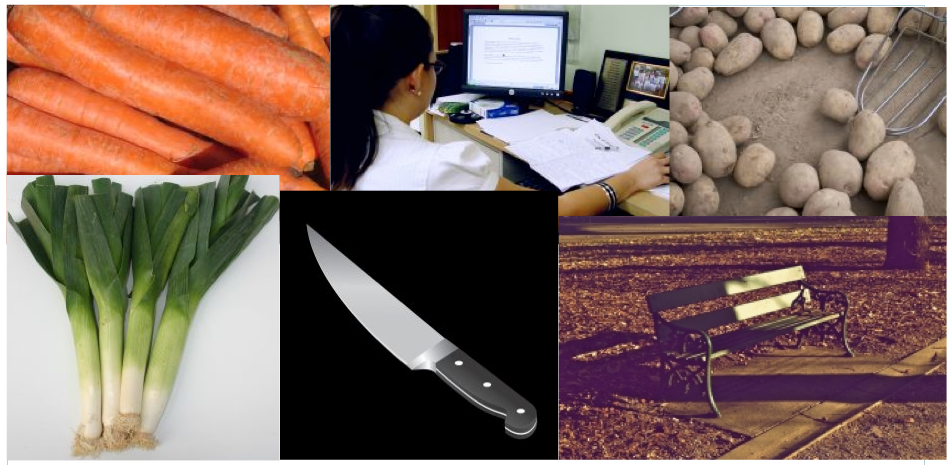
Picture activity for The Cook (Chapter 5)

Look again at The Cook (Chapter 5) and find the words or phrases represented by the pictures below

Tagged , ,

Grammar and comprehension The Cook (Chapter 4)

1. To make a statement in the past tense negative, we often use ‘did’. The main verb in the statement also changes: it becomes the bare infinitive.

For example, ‘Candy didn’t take a bus to the school; instead, she walked there.

2. Look at these sentences about The Cook (Chapter 4) and fill in the gaps using the example above to help you.

a. Candy ______ ______ the plates of food out of the kitchen nervously; instead, she brought them out ______.

b. Mrs Duffy ______ ______ that the food smelled horrible; instead, she ______ it smelled ______.

c. Mr Tomkin ______ ______ much; instead, he kept quiet and just ______ his head.

d. The headmistress ______ ______  time ; instead, she ______ Candy the job immediately.

Tagged , , ,

Grammar for The Cook (Chapter 4)

1. Look at this extract from The Cook (Chapter 4). The ‘When‘ question’s main verb is in the simple present tense. The auxillary or helping verb is ‘do‘. It isn’t ‘does‘ because it must agree with ‘you‘ – and it isn’t ‘did‘ because the question isn’t about the past.

The headmistress stood up and offered her hand. ‘Congratulations, Ms Pickles. You are our new school cook. When do you want to start?’

2. If the subject of a simple present tense question is he/she/it, the auxillary verb changes to ‘does‘. NOTE: the main verb remains unchanged (in other words, we DON’T add ‘s‘ to it). For example, ‘Where does he work?‘. In this question, the subject is ‘he‘, the main verb is ‘work‘ and the auxillary verb is ‘does‘.

3. Complete these questions

a. “Where ______ you ______ to ______?”   “Let’s go to McDonalds!”

b. ‘When ______ he ______ work?”   “He started at 8, so he’ll finish at 4”

c. “Where ______ Robert and Eva ______?”   “In Abu Dhabi. They moved there last year.”

d. “When ______ Tommy ______ school?”   “Next year, when he is five years old”

e. “Why ______ she ______ living there?”   “She says she likes British food!”

Tagged , , ,

Quizlet for The Cook (Chapter 4)

You can practise the vocabulary from The Cook, Chapter 4 here in this QUIZLET 

Tagged ,

Comprehension for The Cook (Chapter 4)

Look again at The Cook (Chapter 4). According to the text, is the information in the following statements True, False or Not Given?

a. Candy took more than two hours to make the meal

b. Candy made a salad as a starter

c. Mrs Duffy disagreed with the headmistress’s opinion about the food

d. Mr Tomkin thought the food was good too

e. The headmistress offered Candy a job

f. The headmistress did not mention the salary

g. Candy wants to start the job immediately

Tagged ,

Grammar for The Cook (Chapter 4)

1. Look at this sentence from The Cook (Chapter 4):

‘This is the best school food I’ve ever tasted!’

2. This could be said another way: ‘The food is really good. In fact, it is the best (food that) I have ever tasted.’

Notice that the verb ‘taste’ is in past participle form (=tasted)

3. Look at these examples and choose the correct one

i. The hotel is really good. In fact, it’s the best I’ve ever (stay/stayed) in.

ii. The service on this flight is really good. In fact, it’s the best I’ve ever (have/had).

iii. The movie is really bad. In fact, it’s the worst I’ve ever (seen/saw).

4. Now complete these sentences

i. The bed is really good. In fact, it’s the most comfortable….

ii. The water in this swimming pool is really cold. In fact, it’s the coldest…

iii. The food is disgusting. In fact, it’s the worst…

Tagged , , ,

Picture activity for The Cook (Chapter 4)

Find the words or phrases in The Cook (Chapter 4) that match these pictures

Tagged , ,

Comprehension for The Cook (Chapter 3)

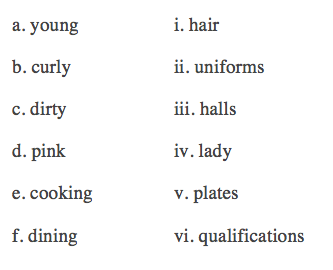
Look again at Chapter 3 of The Cook and match the adjective with the noun to make the correct noun phrase

Tagged ,

Comprehension for The Cook (Chapter 3) – order and referents

1. Look again at The Cook (Chapter 3) and put the following sentences in order:

i. His teeth and eyes scared her

ii. They put the dishes into it

iii. Candy told them that she had none of them

iv. He agreed to allow her to make it

v. They emptied them

vi. She said her food was very bad

2. Now look again at all the subject pronouns (he, she, they), possessive adjectives (his, her) and object pronouns (it, her, them…) in the sentences above and say who or what they refer to. For example, in the first sentence (i. His teeth and eyes scared her), ‘his‘ = Mr Tomkin’s and ‘her‘ = Candy

Tagged , ,

Grammar for The Cook (Chapter 3)

1. There are a number of possessive adjectives in English (his, her, its, our, your, their, my). Using a possessive adjective is another way to show that something belongs to someone. For example, we can write the sentence ‘The man’s narrow eyes frightened her‘, a different way using a possessive adjective – ‘His narrow eyes frightened her.’ In this sentence, the possessive adjective ‘His‘ accompanies the noun phrase ‘narrow eyes

2. Look at this extract from The Cook (Chapter 3) and find examples of possessive adjectives. What are the noun phrases that accompany the possessive adjectives? [Watch out for ‘her’ – it can also be an object pronoun]

Inside the school’s dining hall, two ladies in pink uniforms collected dirty plates and took them to the kitchen. Lunch finished twenty minutes ago and now it was their job to clean everything. They emptied the plates, put them in the dishwashers and went to fetch more from the tables. They did not look at the four people at the back of the room.

‘Ms Pickles,’ began the man, ‘you don’t have any cooking qualifications. Is that correct?’

This was her big chance. She wanted to work, to start again; but the man’s narrow, grey eyes and his small, sharp teeth frightened her.

3. Look at these sentences. Decide if ‘her’ is being used as a possessive adjective or object pronoun

a. I gave her my book

b. Her family name is ‘Smith’

c. I spoke to her brother last night

d. Her favourite actor won an award

e. I don’t know her very well, but I know her older sister

f. The man’s narrow eyes frightened her


Tagged , , ,

QUIZLET for The Cook (Chapter 3)

Here is the QUIZLET for The Cook (Chapter 3). You can practice your vocabulary using it.

Tagged ,

Comprehension for The Cook (Chapter 3)

Look again at The Cook (Chapter 3) and decide if the information in these statements is true, false or not given.

1. There were at least six people in the dining hall

2. The two ladies in pink uniforms worked part-time at the school

3. Mrs Duffy was the headmistress

4. Candy had no cooking qualifications

5. Everyone liked the meals that the last cook made

6. The last cook had no qualifications

7. Candy offered to prepare a meal immediately

8. The meal that Candy will make is difficult to cook

Tagged ,

Picture activity for The Cook (Chapter 3)

Look again at Chapter 3 of The Cook and find the words (or phrases) to match these pictures.

Tagged , ,

Comprehension for The Cook (Chapter 2) Past tense negatives

1. To make some simple past tense statements negative, the auxilliary verb ‘did’ must be added. The main verb must also change from simple past to bare infinitive For example, ‘She ate breakfast‘ becomes ‘She did not eat breakfast’/She didn’t eat breakfast‘ . However, with some verbs (such as ‘To Be’) the auxilliary ‘did’ is not used. For example, ‘She was late‘ becomes ‘She was not late/She wasn’t late.

2. Look at these sentences from The Cook (Chapter 2). Decide if they are true or false.

a. Candy didn’t find it easy to get to the school.

b. Candy asked some people for directions.

c. Most of the people that she asked gave her help.

d. The old woman didn’t know where the school was.

e. The school wasn’t far from the fish and chip shop.

f. Candy didn’t feel hungry.

g. Candy didn’t have a scarf around her neck.

Tagged ,

Grammar for The Cook (Chapter 2)

1. When a parallel structure is used, words make a pattern because the same structure is repeated. For example, sometimes a noun is repeated: ‘My favourite cities are London, New York and Edinburgh.’ In this example, the parallel structure comes from having three nouns (London, New York and Edinburgh) repeated. Sometimes a verb (in the same tense) is repeated. For example, ‘Don’t eat and talk at the same time!’ In this case, the parallel structure comes from repeating two bare infinitives (‘eat’ and ‘talk’).

2. Look at this example from The Cook (Chapter 2) can you find examples of parallel structures?

Tagged , , ,