Monthly Archives: October 2012

Subject / Verb agreement

SUBJECT/VERB AGREEMENT

1.Subject/verb agreement

This simply means that the verb (or auxiliary verb) must pay attention to whether the subject is singular or plural. Look at this sentence: ‘The teacher was standing at the window’. In this sentence, the subject is ‘the teacher’. There is just one teacher, so the subject is singular. Because the subject is singular, the verb must ‘match’ it. Therefore, the correct (auxiliary) verb form is ‘was’ (and not ‘were‘).

2. Look at this paragraph from Sweet tooth (ch3). Look at the subjects of each sentence and how the verbs or auxiliary verbs agree.

The time was just after 5.20. She was walking slowly down the main street of Narbury, one hand on the side of her face. Behind her, Supersave was shutting. Most of the other shops were already closed. Everywhere, people were hurrying home, returning to their families. But not Wendy. She had phoned the dentist, Cedric Links, during her lunch break and now she had an emergency appointment for 5.30.

3. Choose the correct form of the verb in these sentences

a. Tracey and Wendy [was/were] old friends.

b. Tracey [wasn’t/weren’t] afraid to go to the dentist but Wendy [were/was].

c. A little train [was/were] going round a track in the toy shop window.

d. The lane that Wendy went into [was/were] very dark.

e. When Wendy looked at Mrs Morton’s face, she saw that the old woman [was/were] missing her front tooth.

f. Tracey thought that the new dentist [was/were] really good.

4. Sentences that start with ‘There’. Although ‘There’ is in the subject position, the ‘true’ subject is somewhere else! Try to find the subject, decide if it is singular or plural and choose the correct answer.

a. There [was/were] a toy shop amongst the many shops in Narbury.

b. There [was/were] a staircase with many stairs that led to the new dentist’s office.

c. There [was/were] a lot of people on the street at 5pm.


Tagged ,

Sweet tooth (Ch3) Quizlet

Practise some of the words from Sweet tooth (Ch3) with this QUIZLET

Tagged

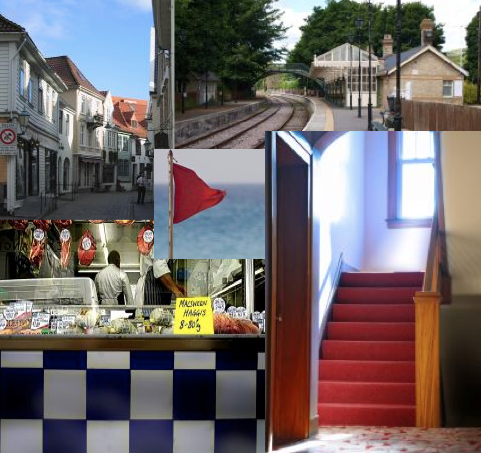
Picture activity for Sweet tooth (Ch3)

Match these words from Sweet tooth (Ch3) with the pictures:

a staircase

a lane

a butcher’s shop

a train station

a flag


Tagged

Sweet tooth (Ch2) reading comprehension

1. Look again at Sweet tooth (Ch2) and decide if the following statements are true or false.

a.Wendy knew a lady called Mrs Wilson

b. Mrs Wilson told Wendy about the new dentist.

c. The new dentist took out three of Mrs Wilson’s teeth.

d. Tracey has been to see the new dentist.

e. Tracey told Wendy that she was going to see the new dentist before she went there.

f. Wendy was happy with the treatment that she got from the new dentist.

g. Wendy could see that Mrs Morton was missing a back tooth.

Tagged

Grammar for Sweet tooth (Ch2) – The Genitive (‘s)

THE GENITIVE

1. The genitive’s form is identical to the form of two contractions

To show that something belongs to someone or something, we often use the genitive. The genitive = ‘s. For example, “The man’s car wouldn’t start because it had run out of petrol.” Here, ‘s means the car belongs to the man.

The contraction (shortening) of ‘is’ and ‘has’ produces a form that is identical to the genitive. In other words, all of them = ‘s

EXAMPLES: “He has gone to see a movie’ = “He’s gone to see a movie” and “He is in the cinema” = “He’s in the cinema”

2. Look again at this extract from Sweet tooth (Ch2). Can you find two examples of the genitive and one of a contraction? Is it the contraction for ‘has or the contraction for ‘is’?

The dentist’s name is Cedric Links. She couldn’t stop talking about him…’

‘Did Mrs. Wilson get a tooth out?’

‘Not just one,’ Tracey replied, counting out the customer’s change. ‘Two.’

‘TWO!’ Wendy cried.

‘See you later. Bye,’ Tracey said to the customer and turned to Wendy again. ‘I went along and got a check-up too.’

‘You didn’t tell me.’

Tracey shrugged. ‘It’s no big deal. Anyway, he was great.

3. Decide if the ‘s in these sentences are examples of the genitive, a contraction of ‘is’, or a contraction of ‘has’.

a. The book that he’s reading was written by his father’s best friend.

b. What’s the name of the company that repaired your car’s windscreen?

c. My iPad’s screen was badly damaged when I dropped it, so now I have to use my wife’s.

d. The website’s been visited by over ten thousand people since its beginning and the number’s growing.


Tagged ,

Quizlet for Sweet tooth (Ch2)

Practice some of the words from Sweet tooth (Ch2) using this QUIZLET.

Tagged

Picture activity for Sweet tooth (Ch2)

Look again at Sweet tooth (Ch2) and match the pictures with the words from that chapter:

a till

purple

crisps

a conveyor belt


Tagged

Vocabulary practice for Sweet tooth (Ch1)

Use this QUIZLET to practice some of the words in Sweet tooth (Ch1)


Tagged

Reading comprehension for Sweet tooth (Ch1)

Read Sweet tooth (Ch1) again. Without looking at it, decide if the following statements are true or false

1. Wendy hates going to see a dentist.

2. Wendy works in SuperSave.

3. SuperSave is a supermarket.

4. Tracey and Wendy have been working together for three years.

5. Tracey attended the same school as Wendy.

6. Tracy and Wendy normally work four days a week.

7. The closest dentist to Wendy and Tracey is in Eastfields.

8. Tracy doesn’t recommend the new dentist that she has found.


Tagged

Picture activity for Sweet tooth (Ch1)

Match these words from Sweet tooth (Ch1) to the pictures:

tooth

can

painkiller

chewing gum

supermarket


Tagged

Grammar for Sweet tooth (Ch1)

INFINITIVES

1. Look at this sentence from Sweet tooth (Ch1):

Jobs were hard to find

In this sentence, the basic structure looks like this: Subject + to be + adjective + infinitive

2. Complete the following sentences using the correct adjective + infinitive 

simple to use/difficult to change/difficult to answer/easy to read/difficult to understand

a. Their accents were ______, so I asked them to repeat what they said.

b. The book was ______, so I finished it in just three days.

c. One of the exam questions was ______, so I went back to it later and tried again.

d. The tire was ______, but luckily there was a garage nearby.

e. The iPhone 5 is ______, but it is quite expensive.

For more practice with infinitives, try this site: http://www.grammar-quizzes.com/infinitive4.html


Tagged ,

Quizlet for The Piper

Practise some of the words from The Piper using this QUIZLET.

Grammar for The Piper

Look at our new very short story called The Piper in the section called ‘FLASH FICTION’.

Think‘, ‘know‘, ‘feel‘, ‘wish‘, ‘see‘ and ‘guess‘ are common verbs in English. Often the verbs follow this pattern: SUBJECT +VERB + THAT + NOUN CLAUSE. For example, ‘The piper thought that the man was about fifty years old‘. In this example, the SUBJECT = ‘The piper‘, the MAIN VERB = ‘thought‘, and the NOUN CLAUSE = ‘the man was about fifty years old‘. The subject of the noun clause = the man, and the verb in the noun clause = was.

A. Put these sentences into the correct order.

1. | wished | that he |speak | languages| a hundred | The piper | could

2. | that | The piper | the man | Scottish | guessed | was

3. | felt | a happy | cheer | The piper | that | tune | would | him up

4. | he had | at least | The piper | that | knew | to get |every day | ten pounds

5. | the woman | The piper | gave | saw | him a pound |that

B. Complete these sentences

1. The piper thought that the man was about fifty because…

2. The piper saw that he could stop playing soon because…

3. The piper wished that everyone would give him ten pounds because….

4. The piper wished that he could tell people to run away because….


Tagged ,

Reading comprehension with ‘before’ and ‘after’

Read the Lake (Ch16) again and complete the following sentences using either ‘before’ or ‘after’.

1. Sheriff Farley arrived at Ben Green’s garage ______ Big Donnie Brown got there.

2. ______ Sheriff Farley parked his car, Big Donnie arrived.

3. ______ Sheriff Farley sent Donnie the blackmail letter, he would be rich.

4. Sheriff Farley put on the grey wig ______ Donnie Brown left Ben Green’s garage.

5. ______ Sheriff Farley opened Donnie’s front gate with a skeleton key, he drove all over the property in the red Ford.

6. ______ Sheriff Farley heard the noise of the shutters falling, he saw Donnie walk towards the grey Buick.

7. Sheriff Farley thought about his pension ______ he followed Donnie.

8. ______ Donnie drove off, Sheriff Farley stamped on the accelerator pedal.


Tagged ,

Grammar for The Lake (Ch16)

THE PAST PERFECT

The past perfect looks like this: had + past participle

In relation to a simple past tense, the past perfect is often used to move to an earlier past.

Look at this sentence from The Lake (Ch16): ‘He yawned and looked at his watch. It was only 8pm. He hadn’t had a good night’s sleep in weeks.’

The yawn and the look took place in the past – the use of the simple past tense indicates this. However, the lack of ‘a good night’s sleep’ (which means the person slept badly) happened BEFORE the yawn and BEFORE the look. The past perfect has taken the narrative into a more distant past – a time before the other two events (yawn, look)

Here is another example from the Lake (Ch16): ‘Farley started up the engine of the old Ford. He had had to deal with lots of criminals over the years – and a lot of bent cops.’  

Are the following statements TRUE or FALSE?

1. ‘Farley started up the engine’ 

This is an example of a sentence that uses the past perfect

2. Farley started the engine BEFORE he dealt with a lot of criminals

3. ‘He had had to deal with a lot of criminals’

This is an example of a sentence that uses the past perfect

4. Farley dealt with the criminals AFTER he started up the engine

For more practice with the past perfect, visit this site:http://www.bbc.co.uk/worldservice/learningenglish/grammar/learnit/learnitv210.shtml


Tagged ,

Vocabulary practice for The Lake (Ch16)

Use this QUIZLET to practise the vocabulary of The Lake (Ch16)

Tagged