Match these words from Sweet tooth (Ch7) with the pictures
1. gold
2. gums
3. a counter
4. a scarf
5. pills


Match these words from Sweet tooth (Ch7) with the pictures
1. gold
2. gums
3. a counter
4. a scarf
5. pills
Look again at Sweet tooth (Ch6). Are the following statements true or false?
1. The strange noise was caused by Wendy.
2. Pliers were used to take out Wendy’s tooth.
3. Wendy smiled at Links.
4. There was pink liquid in a cup next to Wendy.
5. The pink liquid was for drinking.
6. Links wanted to see Wendy in a month’s time.
7. Links found another tooth that he wanted to take out.
8. Ms Simm had gone when Wendy went into the reception area.
THE USE OF COULD
1. Look at this extract from Sweet tooth (Ch6)
She could hear Links breathing.
2. How to use ‘could’.
One way to use ‘could’ is to talk about ability in the past; for example, ‘He could run fast when he was young.’ Another way to use ‘could’ is to talk about a possibility; for example ‘Take an umbrella – it could rain later.’ Look at the extract from Sweet tooth above. How is ‘could’ being used in it?
3. Look at these sentences. Is could being used to talk about past ability or possibility?
a. I couldn’t find his home number so I called him on his mobile.
b. He isn’t answering his mobile. Could he be asleep?
c. He could be asleep so wait and call him later.
d. When I spoke to him, the line wasn’t clear and I couldn’t hear what he said.
e. Could you understand anything that he said?
f. I could only understand every second word!
Practise some of the words from Sweet tooth (Ch6) using this QUIZLET
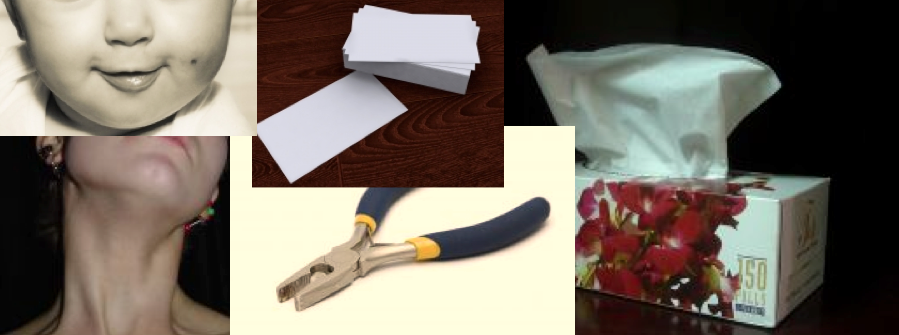
Look at these words from Sweet tooth (Ch6) and match them with the correct picture:
a paper hankerchief
a card
a smile
pliers
a throat
Click on this QUIZLET to practice the words in Sweet tooth (Ch5)
Look at chapters 4 and 5 of Sweet tooth. Complete these sentences using either ‘before’ or ‘after’
1. ______ Wendy reached the top of the stairs, she listened but heard no sound.
2. Wendy wondered if she had made a mistake with the date of the appointment ______ she opened the dentist’s door.
3. ______ a loud buzzer sounded on the receptionist’s desk, the woman told Wendy to go in and see the dentist.
4. Wendy felt a little nervous ______ she went in to see the dentist.
5. Wendy thought the woman looked like a raven ______ she went in to see the dentist.
6. ______ the woman reassured Wendy, Wendy noticed that the woman had sharp teeth.
7. ______ the dentist appeared, Wendy thought about leaving.
8. The dentist pulled over a large light ______ he began to examine Wendy’s teeth.
9. ______ the dentist said ‘Streptococcus mutans’, he explained that it meant tooth decay.
10. _______ the dentist used the needle, he told Wendy to sit and wait.
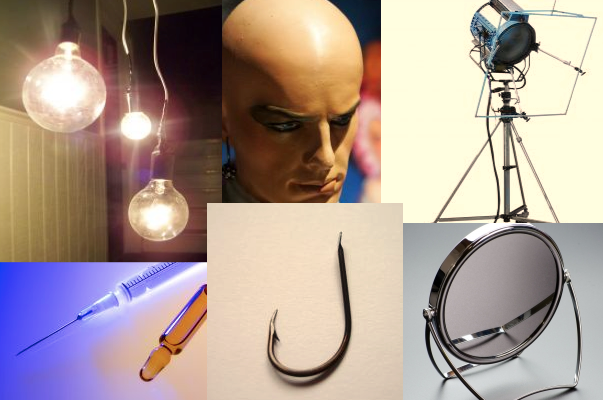
Match these words from Sweet tooth (Ch5) with the pictures:
bald
a searchlight
a bare bulb
a mirror
a hook
a needle
1. Look again at Sweet tooth (Ch4) and decide if the following statements are true or false
a. The dentist’s surgery was on the ground floor.
b. The dentist had an assistant.
c. Wendy was asked for her telephone number.
d. Wendy had to wait for a long time before she saw the dentist.
e. Wendy was feeling anxious about seeing the dentist.
f. Wendy changed her mind and ran out of the surgery.
NOUN CLAUSES
1. A noun clause is a part of a sentence that acts like a noun.
Look at this sentence: “I know that he is angry“. Often noun clauses begin with ‘that‘ or ‘what, who, why, when and how‘. The example sentence could be re-written as ‘I know it.’
2. There is an example of a noun clause in this extract from Sweet tooth (Ch4). Can you find it?
Puzzled, Wendy turned and met the woman’s stare. ‘A raven!’ thought Wendy. ‘That’s what she looks like – a raven.’
(The correct answer is ‘….what she looks like’)
3. Here are some more sentences. Can you find the noun clauses in them?
a. I can’t remember where I left my phone.
b. I know who knows the answer.
c. I understand what you are saying but I don’t agree.
d. I forgot when we planned to meet.
e. I don’t know why you don’t like Manchester United.
f. We discussed who the best person for the job was.
g. What you said was correct.
h. I don’t understand how you got that answer.
4. Try to make some noun clauses of your own by completing these stems
a. I know what…
b. I don’t know where…
c. I can’t remember when…
d. I understand that…
Use this QUIZLET to practise some of the vocabulary from Sweet tooth (Ch4)
Look at the words from Sweet tooth (Ch4) below and match them with the pictures
stone
a raven
broken glass
a wooden chair
a uniform
a heart

Look at Sweet tooth (Ch1, 2 and 3). Can you complete the sentences using the words below to help you?
red gold good work co-worker train easy hated
1. Wendy ______ going to the dentist
2. Tracey was Wendy’s ______ and also an old school friend.
3. Jobs weren’t ______ to find in the town that Wendy and Tracey lived in.
4. Mrs Wilson told Tracey that the new dentist was very ______.
5. Wendy made an appointment to see the new dentist after she finished her ______.
6. Wendy watched the ______ in the toy shop’s window.
7. The name of the new dentist was written in ______ letters.
8. A ______ arrow pointed upstairs.
SUBJECT/VERB AGREEMENT
1.Subject/verb agreement
This simply means that the verb (or auxiliary verb) must pay attention to whether the subject is singular or plural. Look at this sentence: ‘The teacher was standing at the window’. In this sentence, the subject is ‘the teacher’. There is just one teacher, so the subject is singular. Because the subject is singular, the verb must ‘match’ it. Therefore, the correct (auxiliary) verb form is ‘was’ (and not ‘were‘).
2. Look at this paragraph from Sweet tooth (ch3). Look at the subjects of each sentence and how the verbs or auxiliary verbs agree.
The time was just after 5.20. She was walking slowly down the main street of Narbury, one hand on the side of her face. Behind her, Supersave was shutting. Most of the other shops were already closed. Everywhere, people were hurrying home, returning to their families. But not Wendy. She had phoned the dentist, Cedric Links, during her lunch break and now she had an emergency appointment for 5.30.
3. Choose the correct form of the verb in these sentences
a. Tracey and Wendy [was/were] old friends.
b. Tracey [wasn’t/weren’t] afraid to go to the dentist but Wendy [were/was].
c. A little train [was/were] going round a track in the toy shop window.
d. The lane that Wendy went into [was/were] very dark.
e. When Wendy looked at Mrs Morton’s face, she saw that the old woman [was/were] missing her front tooth.
f. Tracey thought that the new dentist [was/were] really good.
4. Sentences that start with ‘There’. Although ‘There’ is in the subject position, the ‘true’ subject is somewhere else! Try to find the subject, decide if it is singular or plural and choose the correct answer.
a. There [was/were] a toy shop amongst the many shops in Narbury.
b. There [was/were] a staircase with many stairs that led to the new dentist’s office.
c. There [was/were] a lot of people on the street at 5pm.
Practise some of the words from Sweet tooth (Ch3) with this QUIZLET
Match these words from Sweet tooth (Ch3) with the pictures:
a staircase
a lane
a butcher’s shop
a train station
a flag

1. Look again at Sweet tooth (Ch2) and decide if the following statements are true or false.
a.Wendy knew a lady called Mrs Wilson
b. Mrs Wilson told Wendy about the new dentist.
c. The new dentist took out three of Mrs Wilson’s teeth.
d. Tracey has been to see the new dentist.
e. Tracey told Wendy that she was going to see the new dentist before she went there.
f. Wendy was happy with the treatment that she got from the new dentist.
g. Wendy could see that Mrs Morton was missing a back tooth.
THE GENITIVE
1. The genitive’s form is identical to the form of two contractions
To show that something belongs to someone or something, we often use the genitive. The genitive = ‘s. For example, “The man’s car wouldn’t start because it had run out of petrol.” Here, ‘s means the car belongs to the man.
The contraction (shortening) of ‘is’ and ‘has’ produces a form that is identical to the genitive. In other words, all of them = ‘s
EXAMPLES: “He has gone to see a movie’ = “He’s gone to see a movie” and “He is in the cinema” = “He’s in the cinema”
2. Look again at this extract from Sweet tooth (Ch2). Can you find two examples of the genitive and one of a contraction? Is it the contraction for ‘has or the contraction for ‘is’?
The dentist’s name is Cedric Links. She couldn’t stop talking about him…’
‘Did Mrs. Wilson get a tooth out?’
‘Not just one,’ Tracey replied, counting out the customer’s change. ‘Two.’
‘TWO!’ Wendy cried.
‘See you later. Bye,’ Tracey said to the customer and turned to Wendy again. ‘I went along and got a check-up too.’
‘You didn’t tell me.’
Tracey shrugged. ‘It’s no big deal. Anyway, he was great.
3. Decide if the ‘s in these sentences are examples of the genitive, a contraction of ‘is’, or a contraction of ‘has’.
a. The book that he’s reading was written by his father’s best friend.
b. What’s the name of the company that repaired your car’s windscreen?
c. My iPad’s screen was badly damaged when I dropped it, so now I have to use my wife’s.
d. The website’s been visited by over ten thousand people since its beginning and the number’s growing.
Practice some of the words from Sweet tooth (Ch2) using this QUIZLET.
Look again at Sweet tooth (Ch2) and match the pictures with the words from that chapter:
a till
purple
crisps
a conveyor belt

 EFLshorts