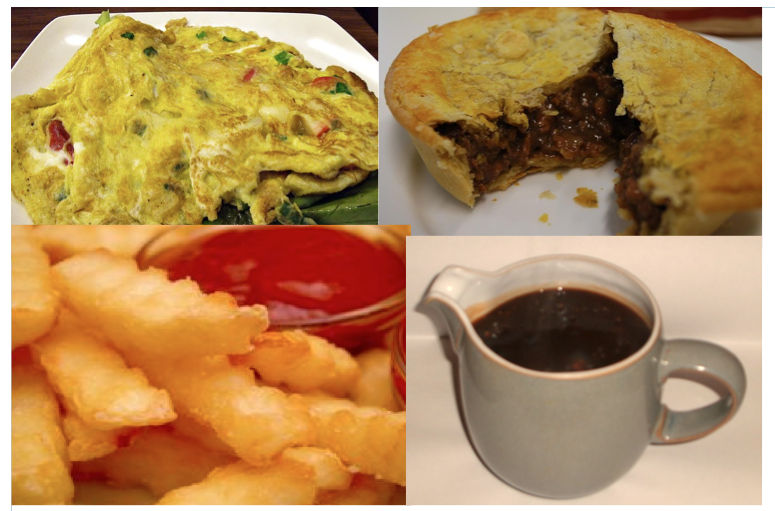
Look again at The Cook (Chapter 10) and find the words that these photographs refer to


Look again at The Cook (Chapter 10) and find the words that these photographs refer to
Look again at The Cook (Chapter 10) and put the following sentences in the correct order
a. Mr Tomkin, Mrs Duffy and the headmistress went to the top of the queue
b. Billy Pugman said ‘Good morning’ to Candy
c. Mr Tomkin noticed that Billy was behaving strangely
d. Mr Tomkin, Mrs Duffy and the headmistress began eating their lunch
e. Mr Tomkin, Mrs Duffy and the headmistress entered the kitchen
f. Billy Pugman asked the boys at the table a question
Use the words below from The Cook (Chapter 9) to complete the sentences
whispering victim formula line clouds
1. There are very few people in the world who know the ______ for Coca Cola.
2. If there are no ______ in the sky, it usually means it isn’t going to rain.
3. The students cheated in the exam by ______ the answers to one another.
4. There was a long ______ of people waiting to see the Coldplay concert.
5. If you are a ______ of bullying at school, you should tell someone in authority.
1. One way to use ‘much‘ and ‘many‘ is to talk about quantities of something. For example, in this sentence: ‘She has many friends‘ the number of friends is countable. ‘Many‘ is used instead of counting the exact number of friends and means ‘a large number of‘. We can also use ‘a lot of‘ instead.
In this sentence: ‘She doesn’t have much patience‘, patience cannot be counted so ‘much‘ is used. This sentence is NEGATIVE. We can also use ‘a lot of” in a NEGATIVE sentence. For example, ‘She doesn’t have a lot of patience‘. If we want to talk about something that cannot be counted in a POSITIVE way, then ‘a lot of‘ is often used. For example, ‘She has a lot of patience‘. This rule changes if ‘so‘ comes before ‘much’. For example, ‘She has so much patience‘. If we want to make a QUESTION, then ‘much‘ or ‘a lot of‘ can be used. For example, ‘Does she have much/a lot of patience?‘
2. Find the examples of ‘much’ and ‘many’ in this extract from The Cook (Chapter 9)
As usual, she worked beside the window. There were carrots to chop, swedes to smash and potatoes to peel and they all took so much time to do. Slowly, the sun rose between grey clouds. Around 8.15, the first children came through the security door and by 8.45 most of the children were in the playground.
She looked and looked for Billy, but there were so many children and none of them stayed in the same place for a second!
3. Use either ‘much’, ‘many’ or ‘a lot of’ to complete these sentences
a. How ______ was the train ticket?
b. She spent ______ money on new clothes.
c. She had ______ fun at her friend’s birthday party.
d. How ______ times did you watch ‘Titanic’?
e. I don’t know how ______ milk is in the fridge. Can you check?
f. He didn’t eat ______ for lunch – just a banana.
Look again at The Cook (Chapter 9) and decide if the information in the following sentences is True, False or Not Given
1. Candy didn’t sleep until 2 a.m.
2. Candy prepared lots of vegetables in the school kitchen
3. The sun rose after candy arrived at school
4. Everyone formed class lines when they heard the school bell
5. Billy hit someone with a football
6. The football struck Billy on his head
7. Billy fell to the ground because a tennis ball hit him
8. Billy didn’t get angry
Practice the vocabulary for The Cook (Chapter 9) using this QUIZLET.
1. There are a number of verbs such as ‘love‘, ‘hate‘, ‘admit‘, ‘stop‘, keep (on)’, ‘begin‘, ‘start‘ and ‘finish‘ that can be followed by a gerund (= verb+ing). For example, at the end of an exam, you might hear this: ‘Stop writing and put your pencils down.‘ In this example, the verb ‘stop‘ is followed by the gerund ‘writing‘.
2. Look at this extract from The Cook (Chapter 9) and find the ‘verb + gerund’ phrases in it.
That night, she found it difficult to sleep. She kept thinking about Billy Pugman. ‘Did it work?’ she kept wondering. ‘Did I use enough of my formula? ’ Finally, the morning came and she got up early and went to the school.
3. Look at these sentences and choose an appropriate gerund from the list to complete them.
going driving practising forgetting doing making
a. “Have you finished ______ your homework?” “Not yet – I still have three pages to read.”
b. Stop ______ mistakes and concentrate!
c. I love ______ to the cinema, but it’s quite expensive these days.
d. I’m sorry. I keep ______ your name. What is it again?
e. I hate ______ in rush hour traffic – it’s really stressful.
f. She loves ______ her English – that’s why she learns words quickly.
Look at these pictures and find the words in The Cook (Chapter 9) that they refer to.

1. Look at this extract from The Cook (Chapter 8) and find the example of ‘let’
‘Oh dear,’ she said, ‘these ones here are a bit cold. Let me get you some fresh ones,’ and she swung around and disappeared through the kitchen doors. In a flash, she put two drops of the purple liquid onto Billy’s steak pie and stirred them into the gravy.
In the example above, Candy uses ‘let‘ to mean ‘allow me‘. In other words, she is using it to make an offer.
2. Using ‘Let’s and let(s)’. Here are two basic ways to use them:
(a) ‘Let me go!’ = Allow/Permit me to do it!
‘Please let me go to the party’ = Allow/permit me to do it
‘Let me get you some water’ = Allow me to get you some water = a phrase used for making AN OFFER
EXAMPLE: A pirate never lets sailors go unless they pay a ransom. = A pirate never allows sailors to go…
(b) Let’s go! = How about going? = A phrase used for making A SUGGESTION.
EXAMPLE: Let’s take some water. We’ll be thirsty if we don’t. = A suggestion to take some water.
3. Now look at the underlined phrase in these sentences. Is it similar to (a) or (b) above?
1. I’m tired. Let’s stop and take a rest.
2. Why won’t you let us go to the party?
3. She never lets her children sit in the car without their seatbelts on.
4. Her father didn’t let her drink coffee when she was a child.
5. If you change your mind, let us know.
6. I don’t know the city so let’s buy a map.
7. Are you hungry? Let me get you some food.
Look again at The Cook (Chapter 8) and put the following sentences in the correct order
a. Billy said that he didn’t want to have the omelette
b. Candy put some of the purple liquid on Billy’s food
c. Billy entered the dining hall
d. Candy went to get some fresh chips
e. Billy chose the steak pie
f. A boy said that the food was excellent
g. Candy stirred the purple liquid into Billy’s food
Practice the vocabulary in The Cook (Chapter 8) in QUIZLET
In chapters 1-8 of The Cook there are a number of informal words and phrases. Usually, informal words and phrases are used with people that we know well such as our friends.
Look at this list:
a. food b. give me c. I don’t think so! d. you can’t change your mind e. not very good f. pounds
Now match the more formal words and phrases above with the more informal ones below:
1. No going back (Chapter 2)
2. He said Manchester United were rubbish (Chapter 5)
3. Give me fifty quid now (Chapter 7)
4. Brilliant grub! (Chapter 8)
5. Gimmie some chips (Chapter 8)
6. Yeah, right! (Chapter 8)
Look at the pictures below and find the words that they refer to in The Cook (Chapter 9)
Think about the Cook (Chapter 7) and put these events into the correct order
a. She gave the landlord some money
b. There was a loud noise and smoke rose into the air
c. She went to some nearby shops
d. She found a room that was not far from a train station
e. The liquid in the pot was deep purple
f. She returned from the shops with the ingredients that she needed
1. The word ‘too’ can be used a number of different ways. One way is to describe a problematic situation. In other words, the situation is not what you expected or wanted. For example, if a classroom has 20 students, but only 19 chairs, then there are too many students (or too few chairs) in the room. Here, ‘too’ is modifying (or changing) a quantifier (such as ‘many’, ‘few’, ‘much’ and ‘little’).
‘Too’ can also be used to modify an adjective. For example, the man usually wears size 43 shoes, but as a gift he was given size 44 so the shoes are too big.
2. Look at this extract from The Cook (Chapter 7) and find an example of ‘too’.
That night, she found a room near Euston train station. It was small and not very clean, but it was cheap and not too far from the school.
3. Complete these sentences using ‘to’ or too’
a. She went ______ the sale at H&M, but she was ______ late ______ get any bargains.
b. The teacher told him ______ do the essay again because he had made ______ many careless mistakes.
c. I have ______ study for an exam tomorrow, but I don’t want ______. I feel ______ tired.
d. I feel full. In fact, I think I ate ______ much.
e. The dress was ______ small, so she took it back ______ the shop where she bought it four months ago. However, the assistant said she was ______ late and refused ______ exchange it.
According to The Cook (Chapter 7), is the information in the following statements true, false or not given?
1. Candy found a place to stay that was near a train station.
2. The place that Candy found was quite close to the school that she worked in.
3. At night, Candy could hear the noise of the trains.
4. The rent for Candy’s room was only fifty pounds a month.
5. To make the liquid that Candy wanted took hours.
6. The liquid that Candy wanted to make was ready before 6am.
7. The liquid that Candy made was a light colour.
8. The deep purple liquid tasted delicious.
Practice the vocabulary for The Cook (Chapter 7) at QUIZLET
Look again at The Cook (Chapter 7) and find the words that these pictures represent

1. Look at this sentence: ‘Candy said goodbye to the dishwashers and left the kitchen.‘
In this sentence, the subject in both clauses is ‘Candy‘ (Candy said goodbye and Candy left..). However, because the subject is the same, there is no need to repeat it. Instead, the two clauses are joined with ‘and‘ and the second ‘Candy‘ is removed.
2. Look at this quote from The Cook and find examples of this kind of ellipsis
The headmistress jumped out of her seat. ‘My dear, I had no idea!’ She pulled some tissues out of a box and gave them to her. ‘Wait here,’ she said and left the room. There were voices outside. A moment later, the headmistress returned. ‘Look, she said, ‘take this.’ In her hands, she had two hundred pounds. ‘Is that enough?
3. Decide if we can remove the word that is underlined in these sentences
a. Candy left the kitchen and Candy went into the playground.
b. Mr Tomkin spoke to Billy and Mr Tomkin told him to go to his office.
c. Candy was in the playground and Mr Tomkin came out the staffroom.
d. Candy used the knife to chop vegetables and the knife shone in the sunlight.
e. The dishwashers heard the fight and the dishwashers told Candy not to go out.
According to The Cook (Chapter 6) is the information in these statements is True, False or Not Given.
1. Lunch finished at 2pm
2. The headmistress arrived in her office just minutes before Candy arrived there
3. Candy was uncomfortable in the park last night
4. The headmistress gave Candy exactly 200 pounds
5. The headmistress has purple hair
6. Billy Pugman gets into six or seven fights every week
7. The police come to the school every time there is a fight
 EFLshorts